
Ingredients
Equipment
Method
- *When using a digital scale always 'tare' out the weight after placing your equipment on it and before you begin to add your ingredient. Then tare out the scale again before adding in the following ingredient. Otherwise you'll have to do a bit of math. Check notes for more info.*
- Place your medium pot onto the digital scale and press tare to zero out the weight. Then weight out the milk directly into the pot.
- If using whole vanilla beans, be very careful on this step! A more detailed instruction will be included in the blog above. Cut your vanilla bean down the center, lengthwise, and carefully scrape out the insides. Then place the scrapings into your pot with the milk. Also toss in the bean "skin" as this will infuse with the milk adding more flavor.If you're using vanilla extract or vanilla paste instead, add that into the milk now.
- Add a literal pinch of salt into your milk mixture.
- Place your large bowl onto the digital scale and tare it out to zero, then one at a time add your egg yolk, sugar, and cornstarch. Make sure to tare out your scale after every added ingredient.
- Gently stir together this mixture, as the cornstarch will fly into the air if you mix too aggressively.
- Using your small bowl scale out your butter and either cut butter into chunks or rip it apart with your hands. Save for later.
- Place your pot with the milk mixture onto the stove and bring to a boil. MILK BOILS OVER QUICKLY. So keep an eye on your pot, and once you notice that the milk is beginning to simmer do NOT take your eyes off of the pot. The moment the milk begins to boil turn off the heat and remove the pot from the stove.
- This next step is where you will temper your egg yolk mixture. Which is very important to ensure a smooth pastry cream. Place your metal strainer over your large bowl.With your 1/2 cup measuring cup scoop up a small amount of the hot milk mixture and pour it through the strainer.
- Immediately whisk the hot milk into your yolk mixture. This is called tempering and prevents your yolks from scrambling. Repeat this action 2-3 more times, whisking until smooth. And scraping the bottom to make sure its fully incorporated.
- Now very carefully strain the remaining milk mixture into your yolks.
- Discard anything that is in the strainer.
- Carefully mix your milk and yolk mixture and pour the entire mixture back into the same large pot from earlier.
- Turn stove onto medium and stir your mixture continuously, until it starts to become thick. Once you see the occasional bubble pop up count to 15 and then remove from the heat.
- Immediately pour this into your second large bowl, it might seem weirdly thick and runny at the same time, THAT IS OKAY! Do not scrape the bottom of the pan, if anything sticks simply discard it.
- Using your wooden spoon or rubber spatula give the mixture a good stir.
- Begin to add your butter chunks, one chunk at a time, stirring well after each addition. Make sure to scrape the sides and bottom while you stir so that it becomes fully incorporated.
- Once your pastry cream is fully mixed, over the bowl with plastic wrap. Youll want to push the wrap down until it touches the pastry cream so that there is no room for air to come between the plastic wrap and the pastry cream.Its okay if your mixture is still warm when you do this step.Then take another piece of plastic wrap and fully cover the bowl.
- Place the covered bowl into the fridge to chill and set overnight.
- The following day remove your plastic wrap and give the pastry cream a stir, and a taste! Keep in mind that the more you stir it the less thick it will become.
Notes
Tare is essentially your "reset" button to bring your scale back to ZERO. If you are using a food scale it should use the term "tare". I know its a weird term, but all that it does is clear any weight currently on the scale. That way you don't need to subtract the weight of your bowls or pans from the weight of your ingredients.
When using a digital food scale always 'tare' out the weight after placing your equipment (i.e. bowl or pot) on it and before you begin to add your ingredient. Then tare out the scale again before adding in the following ingredient. Otherwise you'll have to do a bit of math.
Tempering your yolks prevents the heat of your milk from scrambling the eggs. This is done by slowly drizzling small amounts of the hot liquid into the beaten eggs while constantly whisking to gradually warm the eggs.
Milk is sneaky when it boils! So keep a close eye on it and try not to leave your kitchen while it is on the heat. If it boils over it creates a huge mess, however if it only boils over a small amount then the mixture left in the pot will still be usable and you can continue on with the recipe! You'll just have a bigger mess to clean up.
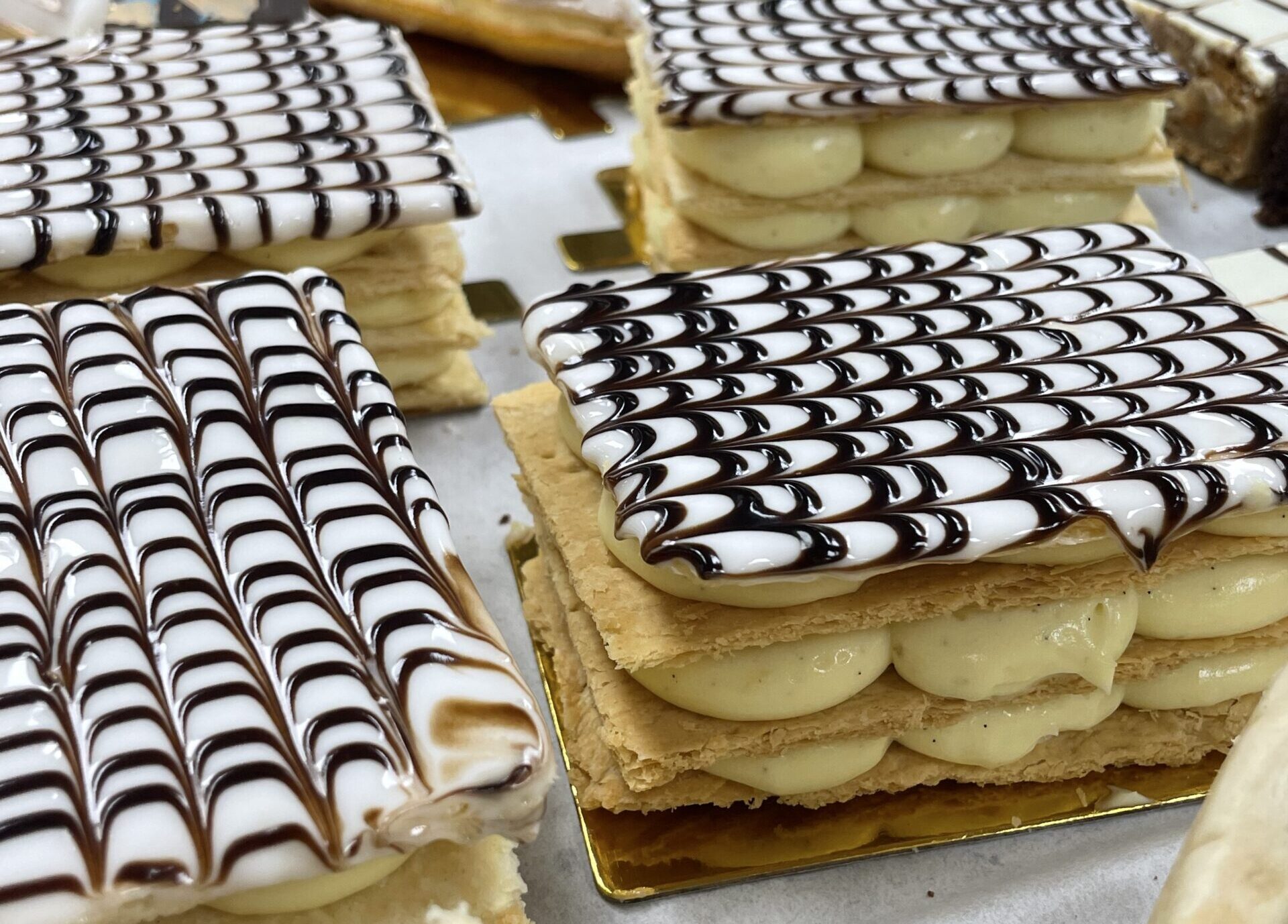
A lot of bakeries in America sell and serve thin pastry cream, so you may not be used to seeing a thicker pastry cream base. However, keep in mind that when you bite into an eclair or cream puff its a lot nicer experience when the creamy center stays in the center! It can be so hard to eat a cream filled pastry when all of your filling squirts out the moment you take a bite! The pastry cream in my Napoleon's above is a beautiful constancy, thick enough where its able to be piped, but not so thick to where it is chunky.
The goal is almost a jiggly pudding constancy.